The Search Revolution: Why SEO, AEO, and GEO Matter in 2026
As we enter the final weeks of 2025, the search landscape is undergoing a profound transformation. What once was dominated by keyword rankings and click-through rates is evolving into a hybrid ecosystem where visibility means far more than appearing on Google’s first page. For businesses navigating this shift, understanding the differences between SEO, AEO, and GEO isn’t just strategic, it’s essential for survival in the digital future.
At Perfiniti, we’ve observed this evolution firsthand. The businesses thriving today aren’t those clinging to traditional search tactics; they’re the ones adapting to a landscape reshaped by voice assistants, artificial intelligence, and generative technologies. Let’s break down what this means for your digital strategy in 2026.
Understanding the Evolution: From SEO to a Hybrid Search Ecosystem
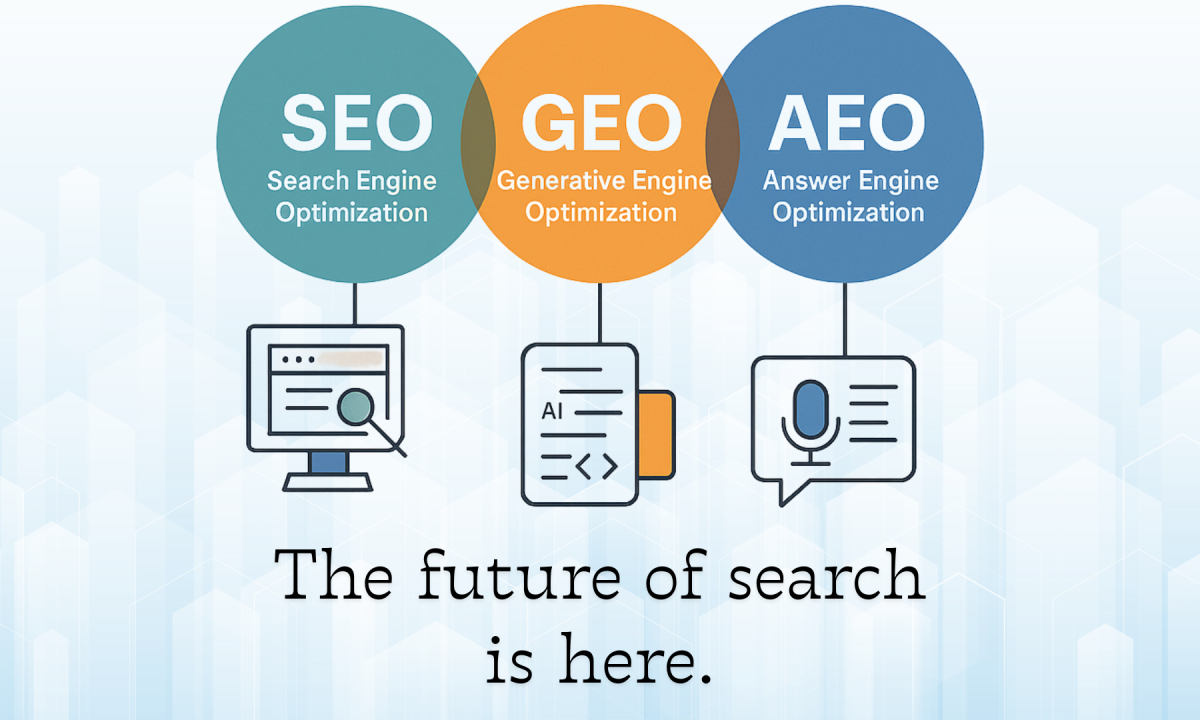
SEO (Search Engine Optimization) remains the foundation. For nearly two decades, SEO has been about mastering keywords, building authoritative backlinks, and optimizing content to rank higher on search engine results pages (SERPs). This approach still works, but it’s no longer enough.
Enter AEO (Answer Engine Optimization). Over 65% of searches now end without a single click to a website. Why? Because AI-powered engines like Google AI Overviews, ChatGPT, Perplexity, and voice assistants provide answers directly on the results page. Gartner predicts that by 2026, 25% of organic search traffic will shift to AI chatbots. AEO focuses on positioning your content as the direct answer to user queries, appearing in featured snippets, voice search results, and AI summaries. It’s about structured data, concise answers, and trust signals, not just rankings.
GEO (Generative Engine Optimization) takes this further. While AEO optimizes for answer engines, GEO optimizes your content for citation within AI-generated responses. Research shows GEO strategies can boost visibility by up to 40% in generative engine responses. The difference? GEO emphasizes content that generative models find trustworthy, retrievable, and citation-worthy through techniques like incorporating statistics, quotations, multimodal optimization, and entity-based strategies.
Why 2026 Demands a Hybrid Approach
The misconception persists that these three strategies compete. They don’t. They complement each other. Businesses that only optimize for traditional SEO miss voice search traffic and AI visibility. Those focusing solely on AEO sacrifice the click-through traffic traditional SEO still drives. The winners in 2026 will be those who blend all three.
Voice search exemplifies this convergence. By 2025, 27% of the global population uses voice search on mobile. Users aren’t saying “best software solutions in India”; they’re asking, “What’s the best software company near me?” This conversational shift demands AEO-optimized Q&A formats while maintaining the structural SEO foundations and the citation-friendly content GEO requires.
The Path Forward
The digital landscape isn’t shifting, it’s fragmenting into multiple discovery channels. Your audience finds information through typed searches, voice commands, AI chatbots, and generative summaries. Neglecting any channel means losing visibility where your competitors are gaining it.
As 2026 approaches, the question isn’t whether to adopt SEO, AEO, or GEO. It’s how to orchestrate all three into a coherent, sustainable visibility strategy. At Perfiniti, we help businesses navigate this hybrid future, ensuring your brand isn’t just found, but cited, trusted, and visible across every discovery channel that matters.
The future of search isn’t about choosing one strategy. It’s about mastering them all.