
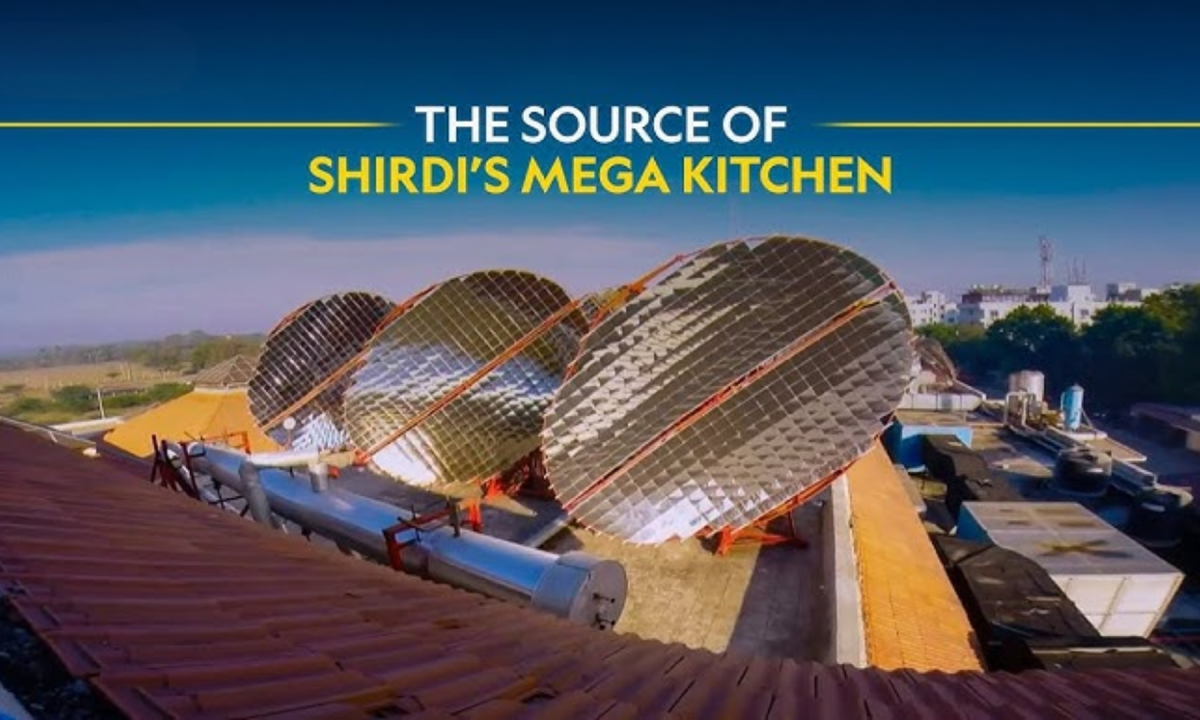
A remarkable example of how renewable energy can power large-scale operations
The viral posts & news articles all over the media made us curious, and we discovered a kitchen that feeds 50,000 people a day… without lighting a gas stove.
Not in Silicon Valley. Not in a futuristic smart city.
In Shirdi, Maharashtra.
At the Shri Saibaba Prasadalaya, one of the world’s largest temple kitchens, food is prepared for 40,000–50,000 devotees every single day.
But the real story isn’t the scale.
It’s what’s happening on the rooftop.
There, 73 giant solar dishes slowly follow the sun across the sky.
Each dish concentrates sunlight to 550–600°C, generating high-pressure steam that flows straight into the kitchen below. That steam cooks tonnes of rice, dal, and vegetables served as prasadalaya meals.
No flames. No gas cylinders. Just sunlight doing the cooking.
The system generates 2,800–4,200 kg of steam every day, helping the temple save nearly 100,000 kg of LPG annually while cutting costs and emissions at the same time.
And in a world where fuel prices spike overnight, and supply chains break during geopolitical crises, that’s not just sustainability.
That’s energy security.
Of course, the kitchen keeps LPG as a backup for cloudy days. But most of the cooking now runs on something local, free, and infinite: the sun.
What fascinates me most is the combination of ancient tradition and modern engineering.
A centuries-old practice of seva, serving food to devotees, now runs on concentrated solar thermal technology.
Faith powered by physics.
And here’s the bigger lesson:
When we talk about the energy transition, we often think about rooftop solar panels and electric cars.
But the real frontier is process heat, the energy used in cooking, manufacturing, textiles, food processing, hospitals, and industry.
Shirdi quietly shows that renewable heat can replace fossil fuels at scale.
No hype. No buzzwords. Just a kitchen that feeds thousands using the sun.
Sometimes the most powerful innovation isn’t in a lab.
It’s in a temple kitchen feeding people every day.
Question: If a temple kitchen can decarbonise cooking for 50,000 people, what’s stopping industries from doing the same?